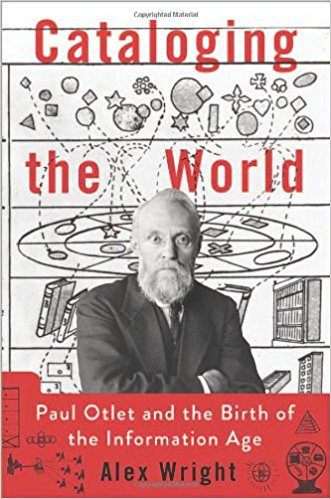
In 1934, fifty years before the first web browser, Paul Otlet imagined a system of networked computers—or “electric telescopes”—that would allow people to search through millions of interlinked documents, images, audio and video files. As the network spread, he foresaw it uniting individuals and institutions of all stripes—from local bookstores and classrooms to universities and governments. He dubbed the whole thing a réseau mondial: a “worldwide network.”
Otlet’s life achievement was the construction of the Mundaneum, a mechanical collective brain —what some have called a “Steampunk version of hypertext.” This visionary experiment was also tragically short-lived. By the time the Nazis carted away Otlet’s collection in 1940, the dream had ended. Broken, Otlet died in 1944.
The book sets out to give Otlet his due, restoring him to his proper place in the long continuum of visionaries and pioneers who have struggled to classify human knowledge, from H.G. Wells and Melvil Dewey to Vannevar Bush, Douglas Engelbart, and Tim Berners-Lee. In the years since Otlet’s death, the world has witnessed the emergence of a digital media ecosystem that has proved him right about the possibilities–and the perils–of a global information network.
REVIEWS
The New Yorker
“Wright’s book revisits Otlet’s story in the light of the ‘data deluge,’ which started in the late nineteenth century and continues to this day. He argues that Otlet discovered a way of thinking about information and its organization that ‘opened the door to an alternative stream of thought, one undergirding our present-day information age.’”
Harper’s
“[Otlet] was a one-man analog Google, with schemes to gather all the world’s information and organize it for universal accessibility… Cataloging the World discerns the origins of Otlet’s theme—how qualities can be made legible through quantification.”
Nature
“Meticulously researched … a fitting tribute.”
Publishers Weekly
“In this enlightening profile, Wright revives and contextualizes the now largely forgotten work of ‘visionary information theorist’ Paul Otlet. Wright is certain that ‘Otlet’s vision for an international knowledge network… points toward a more purposeful vision of what the global network could yet become,’ and his biography could help set that in motion.”
Kirkus Reviews
A “shrewd, brisk biography … illuminating.”
Maria Popova, Brain Pickings
“A remarkable read in its entirety, not only in illuminating history but in extracting from it a beacon for the future.”
George Dyson, author of Turing’s Cathedral
“Alex Wright has placed Paul Otlet’s life and work in up-to-this-minute context to bring us the illuminating biography of a pioneering information activist whose grand vision of a world of universal knowledge, freely available to all, is here to remind us that we would be foolish to settle for anything less.”
Charles B. Strozier, author of Heinz Kohut
“This wonderful, carefully researched, and well written book draws us into the question: to what extent does the ambitious work of Paul Otlet make him the prophetic analog father of the internet? Alex Wright is careful not to overstate the significance of Otlet. But the ambiguity of Otlet’s influence, not to mention his long and eventful life and passionate dreams of world peace, in fact makes him more, not less, interesting.”
W. Boyd Rayward, Professor Emeritus, University of Illinois & University of New South Wales
“Alex Wright’s beautifully written book tells the story of the life and work of a remarkable Belgian utopian, pacifist and information theorist. With great skill Wright analyses Paul Otlet’s ideas and the systems and organisations that he and his colleagues created in the half-century that spans the last decade of the nineteenth century to the time of Otlet’s death in 1944. Wright brings out clearly and comprehensively the ways in which Otlet’s achievements represent a surprising prefiguration of the digital world of today and the technological and systems innovations that underpin our contemporary “information Society.” His book is about personalities in their times and the interplay of invention and communication both then and now. The result is a lively, sympathetic but rigorously recounted exploration of the ways in which what might seem of merely of historical interest is of immediate and engrossing relevance today.”
Wouter Van Acker, Griffith University
“With profound insight, Alex Wright reveals that within the labyrinth of Paul Otlet’s Mundaneum lies hidden an anticipation of the hyperlinked structure of today’s Web. This is not only a captivating biography of Otlet’s prophetic vision of a global networked information system but a vivid account of how similar systems took shape in the minds of Conrad Gessner, Leibniz, Vannevar Bush, Tim Berners-Lee, and many others.”
Dr. Charles van den Heuvel, University of Amsterdam
“Finally a historical study of the Information Age not starting with Vannevar Bush. Alex Wright’s balanced study of Paul Otlet’s dream to catalogue the world as one of the many successive projects of unifying knowledge on a global level is a joy to read after the autohagiographies of engineers that claimed their share in the ‘invention’ of the Internet and World Wide Web in purely computer-and-information-technical terms.”