On July 2, 1886, the printers in the New- York Tribune’s composing room stepped away from their type cases and gathered by the windows, nine floors above Frankfort Street in the heart of the city’s old Newspaper Row. There they watched as a heavy wooden crate inched upward through the summer air, creaking against a block- and- tackle pulley rigged to a flagpole. A man rode atop the crate, guiding it through the tangle of telegraph wires strung in front of the building. When it finally swung in through the open window and the lid was pried loose, the men pressed in to get a look at the two- ton machine now lodged in their midst.
“Most of the hand men didn’t think much of it, and many said so,” remembered John T. Miller, who went on to become the world’s first professional Linotype operator. These were seasoned compositors, union workers who had spent their lives guiding tiny metal pieces of type into place— feeling the nick between their fingers, justifying the margins by hand, trimming or padding reporters’ copy to fit the column measure, and making a thousand other small judgments that left their imprint on the next day’s paper. To such practiced hands, the notion that a machine might displace them seemed not just implausible but faintly absurd. And yet there it stood: a many- armed contraption of brass and steel, assembled from thousands of precisely machined parts. That machine—soon christened the Linotype— would prove one of the most consequential inventions in the history of media. It slashed costs, sped up production (yielding many times the output of a human compositor), and helped propel the mass- market press of the twentieth century. Thomas Edison hailed it as “the eighth wonder of the world,” and admirers celebrated its inventor, Ottmar Mergenthaler, as a latter- day Gutenberg.
But the Linotype did not materialize out of nowhere. It marked the culmination of a century- long transformation of the news trade that had already begun to reshape the contours of American life. That change was driven not by technology alone but by a convergence of political, demographic, and commercial forces— and fueled by the creative energies of thousands of individual printer- publishers spread across a rapidly expanding nation.
The sheer magnitude of this growth was extraordinary. Between the Revolutionary War and 1900, the number of US newspapers rose from thirty- seven to more than twenty thousand. By the century’s end, a nation with just 5 percent of the world’s population was producing more than half its newspapers. It was, as digital humanities scholar Ryan Cordell argues, “the largest text generation platform in human history”— an unprecedented outpouring of print that seeped into nearly every corner of American life.
To foreign visitors, the reach and intensity of American newspapering felt like something to behold. As one traveling Scotsman marveled in 1830, “Every village, nay, almost every hamlet, has its press. . . . The influence and circulation of newspapers is great beyond anything ever known in Europe.” He continued, “In truth, nine- tenths of the population read nothing else.” In the fast- spreading small- town printshops that dotted the countryside, an unruly new media culture took shape. Newspapering evolved from an artisanal literary enterprise catering to the elites into a vast, networked ecosystem in which countless ordinary Americans found a platform to express their views, forge communities, and take part in the great democratic experiment. Alexis de Tocqueville saw the press as nothing less than the essential scaffolding of civil society: “To suppose that [newspapers] only serve to protect freedom would be to diminish their importance: they maintain civilization.” Later historians have echoed this view, arguing that in a young nation lacking common myths or shared traditions, newspapers played a uniquely formative role in shaping the national character. The country was, as historian Page Smith puts it, “held together not by politics, but by words.”
But newspapers are not made of words alone; they also depend on ink, paper, and circulation mechanisms. To meet a burgeoning public appetite for news, printers embraced an expanding arsenal of tools: rotary presses, wood- pulp paper, telegraphs, stereotyping, the Linotype, and more. Ink, too, changed with the times as printers left behind the slow- drying, varnish- and- lampblack inks of the handpress era for newer oil- based formulations that dried quickly and flowed smoothly on high- speed, steam- powered presses. Yet the same technological shifts that helped make newspapers faster and cheaper to produce also bred a creeping sameness, as a noisy, occasionally splotchy print culture gave way to the streamlined conventions of modern journalism.
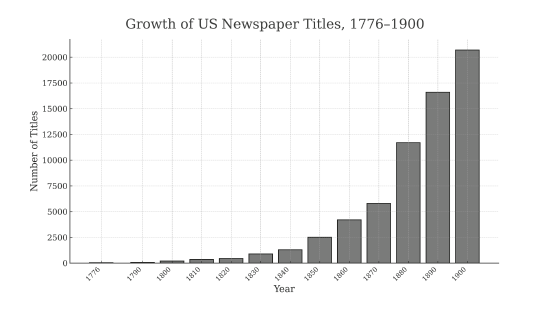
Growth of US newspaper titles, 1776– 1900. Source: Mott, American Journalism; Starr, Creation of the Media; US Census Bureau, Manufactures of the United States in 1860; North, History and Present Condition of the Newspaper and Periodical Press.
By 1900, the rise of a national mass media signaled the closing of a uniquely inventive, freewheeling period in American journalism: a wild, bumptious time, populated by roaming tramp printers, eccentric inventors, gun- slinging frontier editors, passionate social reformers, and literal snake oil salesmen— who together transformed the business of journalism and reshaped the contours of civic life. It was a world teeming with idiosyncratic voices: from literary lions like Mark Twain and Horace Greeley, to lesser- known scribes such as Amelia Bloomer of The Lily, Elias Boudinot of the Cherokee Phoenix, sagebrush humorist Dan De Quille, or eleven- year- old Nellie Williams, editor of the Penfield Extra (also known as “Little Nellie’s Little Paper”). Along with thousands of other anonymous and largely forgotten voices, they embodied a public sphere as unruly and chaotic as the nation itself.
What drove America’s extraordinary zeal for newspapering? Above all, it was the chance for people to make their voices heard. Newspapers offered people a platform to speak, argue, and claim their place in the republic of letters. Printers understood their work in much the same way. In 1813, Albany editor Ebenezer Mack reminded his fellow tradesmen that “it is not at the power of arms that tyranny has to tremble, but at the enlightened mind,” urging them to produce papers “as distinguished for mechanical elegance as for the truth and chasteness of [their] emanations.” For Mack— and for countless printer- publishers— running the presses was both a craft and a civic duty.
Newspapers also functioned as a kind of national connective tissue, knitting together a geographically far- flung country. As the century wore on, new business models emerged— news syndicates, advertising networks, patent- medicine empires— signaling a shift from a partisan press sponsored largely by political parties to one increasingly shaped by the forces of capital and economies of scale. Out of this transformative period arose the great Gilded Age media empires— Pulitzer’s New York World, Hearst’s New York Journal, Ochs’s New York Times— amassing unprecedented power and influence while remaking journalism into its modern form.
This book invites you to explore this overlooked chapter in American history, when the press evolved from a patchwork of small local weeklies into a sprawling, networked public conversation. It does not aim to provide an exhaustive history of American journalism. Barrels of ink have already been spilled chronicling the lives of the great press barons and the subsequent rise of twentieth- century mass media. My focus is on what came before: a period stretching roughly from the American Revolution to the 1880s, when mechanical typesetting and the rise of large national media conglomerates forever altered the economics of news publishing.
Against this backdrop, the story centers largely (though not exclusively) on smaller local papers and the independent printer- publishers, inventors, and entrepreneurs who made them. It explores how newspapers took root not only in urban corridors of power but in smalltown printshops, abolitionist salons, Native American settlements, prairie post offices, soldiers’ tents, hidden vice dens, and even the living rooms of teenagers. In the age before mass media, these overlooked spaces drew thousands of ordinary people into the raucous conversation of American democracy— a flowering of bottom- up, grassroots media that blossomed briefly, only to wither beneath the machinery of an industrializing press. The central lesson of this unruly century still resonates today: that every new communications medium, from the penny press to the digital newsfeed, carries the promise of free expression alongside the risk of consolidating power in fewer hands.
My interest in this project is not purely academic. My ancestors Robert and Sarah Bird Martin worked on small country newspapers in Georgia starting in the 1880s, including Hinesville’s Liberty County Herald, which they owned and operated for four decades. The family carried on the trade, including my great- great- aunt Stella Rimes, who edited and published The Ludowici News for nearly fifty years— often swapping stories on the front porch with her lifelong friend and fellow newspaperwoman Margaret Mitchell (a longtime reporter for The Atlanta Journal, better known to posterity as the author of Gone With the Wind). In her final years, Aunt Stella lived with my family; I remember her at ninety- seven, still reciting poetry by Wordsworth and Longfellow from memory, and reminiscing about her early days working in a country printshop. My mother Sarah Bird Wright carried on the family tradition, starting her career at the Wilmington (North Carolina) Star- News before working as a copy editor and writer for local and national newspapers.
My own professional journey has taken me through the worlds of both journalism and technology— including stints in TV news and magazine writing— before shifting to digital design and research, most recently at The New York Times and Google News. Along the way, I have witnessed firsthand the destabilizing effects of new technologies on the media business— as well as their potential to enable new forms of journalistic expression. These experiences, together with my doctoral research in regenerative design and two earlier books on the history of information systems, have shaped my interest in how media systems adapt, decay, and renew themselves over time.
Over years of working among both journalists and technologists, I have noticed a shared tendency: Neither camp is especially interested in its own history. We live in a culture that prizes innovation yet is often dismissive yoward the past, as technology historian David Edgerton has argued. Journalism historian Peter C. Marzio makes a similar point, observing that “most working journalists care little about the past. . . . They often treat history as an antiquarian pursuit for retirees.” Yet in times of technological upheaval— like the one we are living through now— history can be a vital interpretive tool. And the history of American journalism, as I will argue in these pages, is not just worth preserving; it is ripe for reinterpretation in the digital age.