The Poetess and the She-monster
March 26, 2005
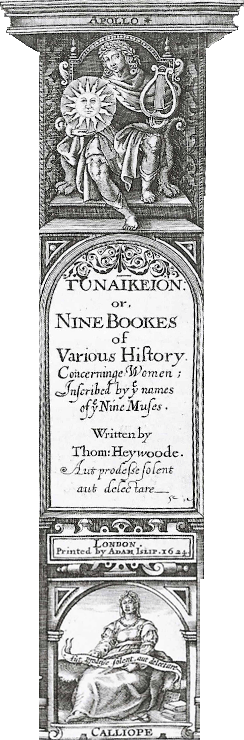 In 1624, the English playwright Thomas Heywood published the Gunaikeion, an encyclopedic study of his favorite subject: women.
Inside this thick volume, readers would find tales of brave queens, learned ladies, chaste damsels, Amazons, witches, even a transgendered woman or two.
Although Heywood's name appears on the cover, the Gunaikeion was really a compilation of material culled from other popular books of the day, condensed, as Heywood put it, into �a small Manuell, containing all the pith and marrow of the greater.�
As one of the earliest such encyclopedic works ever written, the Gunaikeion marks not only a landmark in English literature, but, I believe, a watershed in the history of information architecture.
Like a kind of primordial hypertext, Heywood's book has no conceptual "top" or Aristotelian subject hierarchy. Instead, it employs a kind of descriptive, bottom-up structure that leaves much of the interpretration - and even classification - up to the reader.
In trying to synthesize a vast corpus of recorded knowledge about women, Heywood seemed to grapple with what Crook and Rhodes call the "intractability of his subject matter." Rather than try to shepherd his fair subjects into a fixed, top-down classification, Heywood instead hit upon a novel scheme:
Heywood faced the same problem, albeit on a far more limited scale. Long before anyone started using terms like "intertextuality," Heywood articulated a vision of an information space that emerged through a dialogue between author, readers, and other books that had come before. As Heywood put it, his new book was:
- Valorous Queen
- Murderess
- Transvestite
- or, Practitioner of bestiality
Writing of Queen Elizabeth, Heywood sings her praises in polymorphous terms:
 These symbolic categorizations, as Crooks and Rhodes argue, "throw into startling relief questions of classification and the logical disposition of knowledge in the period before the establishment of classical taxonomies from the late seventeenth through to the nineteenth centuries."
I believe Heywood does more than just call those taxonomies into question. He seems to suggest a strikingly prescient alternative to top-down hierarchies. For example, in considering possible approaches to classifying historical events, Heywood writes:

| Heywood | Ranganathan |
| Person | Personality |
| Place | Space |
| Time Manner | Time |
| Instrument | Energy |
| Matter | Matter |
| Thing | ?? |
Heywood's notions of descriptive classification seem to foreshadow the possibility of the Web itself. As Crook and Rhodes write, �[t]he digressiveness of both hypertext and the Gunaikeion represents a departure from the kind of narrow, linear thinking that we traditionally characterize as male, and approximates more closely to ways of thinking and learning which in our present culture are considered by some to be the result of women�s socialization.�
In other words, Heywood's women - like the Web - resist categorization.
File under: Informatics
_____________________« Dharma art | Flower Mart »
GLUT:
Mastering Information Through the Ages
New Paperback Edition
“A penetrating and highly entertaining meditation on the information age and its historical roots.”
—Los Angeles Times


